
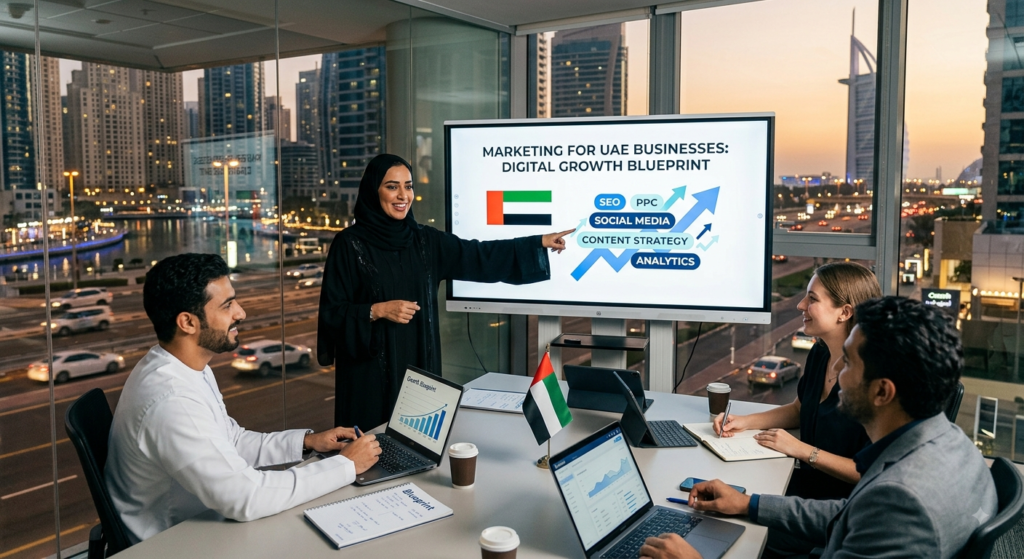
Marketing for UAE Businesses: Digital Growth Blueprint
UAE digital marketing looks different from marketing almost anywhere else in the world. The market blends fast-moving technology with deep cultural roots. A winning Dubai marketing strategy respects both sides of that equation. This guide breaks down what actually works for UAE businesses today. You will learn how local search behavior shapes visibility online. Additionally, you will see why language strategy matters so much in this region. You will also learn how paid ads perform across the wider GCC market. Finally, you will understand the cultural details that make or break a campaign. Whether you run a small shop or a growing enterprise, these lessons apply. The UAE market rewards businesses that plan carefully and respect local context. Businesses that skip this planning phase often waste budget on campaigns that never connect with the intended audience. This blueprint pulls together the practical steps that experienced local marketers actually use. Let us explore each part of this digital growth blueprint step by step. By the end, you will have a clear checklist ready to apply this week.
Local Search in UAE
Local search plays a huge role in how UAE customers discover businesses. Most consumers in Dubai and Abu Dhabi begin their journey with a quick search. Google remains the dominant search engine across the entire country. This holds true across every emirate, from bustling Dubai to quieter northern regions. Therefore, strong local search visibility drives real foot traffic and phone calls. First, every business needs a fully optimized Google Business Profile. This includes accurate hours, photos, and a clear service description. An incomplete or outdated profile quietly pushes potential customers toward competitors instead. Second, local keywords matter more than generic, broad search terms. For example, targeting Dubai marketing strategy performs better than a vague global phrase. Third, customer reviews carry significant weight in UAE search rankings. UAE shoppers read reviews closely before choosing a service provider. A pattern of recent, detailed reviews often outweighs a large volume of old, generic ones. Consequently, businesses should actively request and respond to customer feedback. Responding publicly, in both Arabic and English where relevant, shows genuine attentiveness. This small habit often influences purchase decisions more than people expect. Fourth, location-specific landing pages help each emirate rank on its own. A single generic page rarely captures the nuance of every local market. Businesses operating across Dubai, Abu Dhabi, and Sharjah benefit from tailoring pages to each city’s specific audience and search patterns. Fifth, mobile optimization is essential, since most UAE searches happen on smartphones. A slow or clunky mobile site quickly loses potential customers. Sixth, businesses should claim listings on regional directories beyond Google alone. Local platforms popular in the UAE add another layer of visibility. Seventh, structured data markup helps search engines display richer, more useful results. This small technical step often improves click-through rates noticeably. Local search success in the UAE requires steady, consistent effort over time. It is not a one-time setup task but an ongoing discipline. Businesses that treat local search as a living project consistently outperform competitors who set it up once and forget it.
Arabic + English Strategy
Language strategy sits at the heart of UAE digital marketing success. The UAE is a bilingual market, with Arabic and English both widely used. However, the two languages are not interchangeable in marketing terms. Emirati and other Arabic-speaking customers often prefer Arabic content for trust and comfort. This preference often runs deeper than simple language convenience; it reflects genuine cultural identity and pride. Meanwhile, the large expatriate population frequently searches and shops in English. This group represents the majority of the UAE’s total population, making English content essential rather than optional. Therefore, a strong UAE digital marketing plan includes both languages, done well. This does not mean simply translating one language into the other. Direct translation often misses cultural nuance and natural phrasing. Instead, businesses should create native-quality content in each language separately. Arabic content should reflect local dialect and cultural tone appropriately. English content should stay clear and professional for the diverse expat audience. Additionally, keyword research should happen separately for each language. Search terms rarely translate one-to-one between Arabic and English. A UAE digital marketing strategy that ignores this nuance loses reach and trust. It also risks appearing inauthentic to the very audience it hopes to win over. Businesses that invest in proper bilingual content build stronger local credibility. Working with native-speaking copywriters, rather than relying only on automated tools, makes a visible difference in quality. Customers can often tell within seconds whether content was translated or written naturally. That first impression shapes whether they trust the rest of the page.
Paid Ads in GCC Market
Paid advertising works differently across the wider GCC market than in many Western markets. Google Ads and social media ads both perform strongly across the UAE. The country has one of the highest social media penetration rates in the world. This makes paid social a particularly powerful channel for reaching engaged audiences. However, competition and cost per click vary significantly between emirates. Dubai marketing strategy campaigns often face higher competition than other regions. Meanwhile, Abu Dhabi and Sharjah can offer more affordable entry points. Social media advertising, especially on Instagram and Snapchat, performs exceptionally well regionally. UAE audiences engage heavily with visual, mobile-first advertising content. Therefore, video and image ads often outperform plain text-based campaigns. Additionally, timing matters greatly in the GCC market. Ad performance shifts noticeably during Ramadan and other regional holidays. Smart advertisers adjust messaging and budget around these predictable seasonal shifts. During Ramadan, evening hours often see a sharp rise in mobile engagement, so scheduling ads accordingly can lift results significantly. Currency and payment options also influence ad performance across the region. Ads that mention local payment methods often convert better than generic offers. Testing both Arabic and English ad variations helps identify what truly resonates. A thoughtful paid ads strategy balances reach, cost, and cultural relevance together. Retargeting campaigns also perform particularly well in this market. UAE shoppers often research extensively before making a purchase decision. A well-timed retargeting ad can be the nudge that completes the sale. Budget allocation should flex by emirate, platform, and season rather than staying fixed all year.
Cultural Considerations
Cultural considerations shape nearly every successful UAE marketing campaign. Respect for local customs builds trust that generic marketing simply cannot achieve. First, imagery should reflect modesty standards common across the region. Overly casual or revealing visuals can alienate a significant part of the audience. Second, messaging around family, community, and hospitality resonates strongly here. These themes reflect deeply held cultural values across the UAE. Third, businesses should be mindful during religious observances like Ramadan. Marketing tone often shifts toward generosity and reflection during this period. Fourth, government holidays and national events offer strong, positive marketing moments. Campaigns tied to UAE National Day, for example, often see excellent engagement. Brands that participate authentically, rather than simply adding a flag to their logo, tend to earn far more goodwill. Fifth, working with local marketing partners helps avoid cultural missteps. A team familiar with the region catches issues outsiders might easily miss. Even well-intentioned campaigns from outside agencies sometimes stumble on details that feel obvious to local marketers but invisible to newcomers. Getting these details right takes more than good intentions alone. It takes real cultural understanding paired with strong marketing skill. Sixth, businesses should recognize the diversity within the UAE audience itself. The market includes Emirati nationals alongside a large, varied expatriate community. A single tone rarely fits every group equally well. Segmenting campaigns by audience often produces far stronger, more relevant engagement. Seventh, patience matters when building trust in a relationship-driven business culture. UAE customers often value long-term rapport over quick, transactional interactions. Brands willing to invest in that relationship over months, not just a single campaign, tend to earn stronger loyalty and repeat business.
Conclusion
Marketing for UAE businesses requires more than copying strategies from other regions. It requires a thoughtful blend of local search, bilingual content, smart paid ads, and cultural respect. Businesses that combine these elements build lasting trust and visibility. This blueprint gives you a clear starting point for digital growth in the UAE. As the market keeps evolving, staying close to local behavior will matter even more. Companies that invest in this local nuance consistently outperform generic competitors. A structured, well-executed plan across search, language, ads, and culture creates compounding results over time. Businesses that start now build an advantage that grows stronger with every campaign cycle. The UAE market rewards patience, precision, and genuine cultural respect above flashy, one-off campaigns.

Grow in UAE with Social Prefix strategies. Partner with a team that understands local search, bilingual content, and GCC paid advertising.
Frequently Asked Questions
1. What is the best digital marketing channel for UAE businesses?
Local search and social media advertising both perform strongly. Google Business Profile optimization and Instagram ads typically deliver the fastest visible results.
2. Should UAE businesses market in Arabic, English, or both?
Most successful UAE digital marketing strategies use both languages. Native-quality Arabic content builds trust locally, while English reaches the large expatriate population.
3. How does Ramadan affect UAE marketing campaigns?
Ad engagement often shifts to evening hours during Ramadan. Messaging tone also tends to move toward generosity, family, and community themes.
4. Are paid ads more expensive in Dubai than other emirates?
Yes, Dubai marketing strategy campaigns often face higher competition and cost per click. Abu Dhabi and Sharjah can offer more affordable entry points.
5. Why do cultural considerations matter so much in UAE marketing?
The UAE blends diverse cultures and strong local traditions. Respecting modesty, hospitality, and religious observances builds trust that generic campaigns cannot achieve.