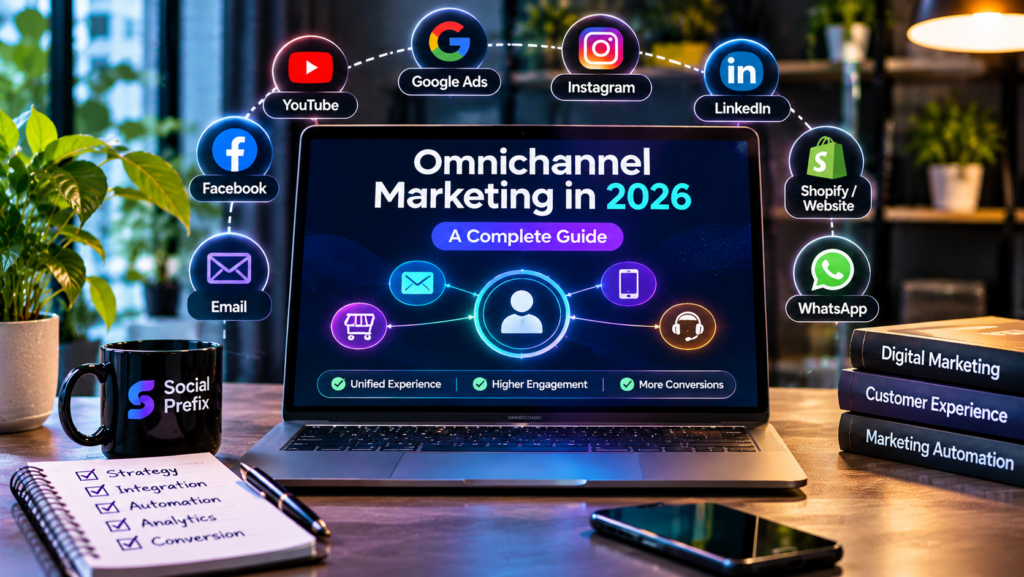
How to Execute Omnichannel Marketing in 2026: Complete Guide
Customers today do not follow a straight path to purchase. They discover brands on social media, research on mobile, compare options on desktop, and buy in-store or through an app. Each interaction shapes their perception. A disconnected experience frustrates them. A seamless one builds loyalty. Omnichannel marketing strategy connects every touchpoint into a single, consistent journey. In 2026, this integrated approach is not just a competitive advantage. It is the baseline expectation for brands that want to grow. This guide breaks down how to build an omnichannel marketing strategy that actually delivers results. Unified Customer Experience The foundation of omnichannel marketing 2026 is a unified customer experience. This means every interaction feels like part of the same conversation, regardless of channel. Many brands confuse multichannel marketing with omnichannel. Multichannel means being present on many platforms. Omnichannel means those platforms work together cohesively. The difference is significant. In a truly unified experience, a customer can start a conversation in a live chat, follow up by email, and complete a purchase in-store without repeating themselves. Their history and preferences carry across every touchpoint. This continuity builds trust. Customers feel recognized and valued. They do not experience the frustration of being treated like a stranger every time they switch channels. Creating this experience starts with customer journey mapping. Identify every touchpoint where customers interact with your brand. Understand the context and expectations at each stage. Additionally, brand consistency plays a central role. Visuals, tone of voice, messaging, and offers must feel cohesive across email, social media, paid ads, physical stores, and customer service. Inconsistency breaks the sense of a unified experience. Furthermore, personalization elevates the unified experience. Using data to tailor messages based on previous behavior makes customers feel understood. Generic mass messages no longer meet the standards customers have in 2026. Channel Integration Channel integration is the operational backbone of any effective integrated marketing strategy. It ensures that marketing, sales, and customer service teams work from the same playbook. Without integration, channels operate in silos. The email team sends one message. The social team sends another. Customer service has no visibility into either. Customers receive conflicting information and the brand loses credibility. Integrated marketing strategy breaks down these silos deliberately. It requires shared goals, shared data, and shared content calendars across all channels. Technology plays a major role in making this happen. Marketing automation platforms like HubSpot, Marketo, and Salesforce Marketing Cloud provide infrastructure for connected campaigns. They allow teams to coordinate messaging across email, SMS, social media, and paid channels from a central system. Content strategy must align across channels as well. A new product launch, for example, should have consistent messaging everywhere. However, the format and tone adapt to each channel’s context. A tweet and an email newsletter deliver the same core message in very different ways. Moreover, paid and organic channels benefit enormously from integration. Retargeting ads that reflect the email content a customer recently opened create a coherent experience that reinforces the message without feeling repetitive. Customer service integration is frequently overlooked. Service agents need access to marketing interaction history. When a customer contacts support, agents should see which campaigns they engaged with, what they purchased, and what issues they had previously. This context dramatically improves service quality. Therefore, invest in connecting your CRM, marketing automation, and customer service platforms. The technical work is worthwhile. The customer experience improvement is visible quickly. Data Synchronization Data is what makes omnichannel marketing work in practice. Without clean, synchronized data flowing across your channels and systems, the unified experience falls apart at the execution level. Data synchronization means that customer information is consistent and current across all systems in real time. When a customer updates their email address in one system, every other system reflects that change immediately. When they make a purchase, their history updates everywhere at once. The challenge is that most businesses have data stored in multiple disconnected systems. An ecommerce platform holds purchase data. An email marketing tool holds engagement data. A CRM holds sales interaction data. A support platform holds service history. These data silos create contradictory customer profiles. Marketing sends a promotional email to a customer who just called to cancel their subscription. The gap between systems produces exactly the kind of experience that destroys loyalty. Solving this requires a customer data platform, or CDP. A CDP collects and unifies data from all sources into a single customer profile. It provides a real-time, comprehensive view of every customer across all touchpoints. Additionally, data quality management is critical. Duplicate records, outdated contact details, and incomplete profiles undermine personalization efforts. Regular data hygiene processes keep your customer database accurate and useful. First-party data has become increasingly important as third-party cookies phase out. Brands need to build direct relationships with customers that generate proprietary data. Email lists, loyalty programs, and customer accounts are primary sources of this valuable first-party data. Similarly, privacy compliance is essential. GDPR, CCPA, and other regulations require transparent data collection and clear consent. Customers must trust that their data is handled responsibly. Non-compliance damages both reputation and bottom line. Consequently, businesses that invest in strong data infrastructure have a lasting competitive advantage. They can personalize at scale, reduce wasted ad spend, and make smarter decisions based on complete customer insights. Measuring ROI Measuring the return on investment of omnichannel marketing is complex. Customers interact with multiple touchpoints before converting. Attributing value accurately requires a thoughtful approach. Traditional last-click attribution assigns all credit for a conversion to the final channel a customer used before purchasing. This model severely undervalues upper-funnel channels like social media and display advertising that contribute to awareness and consideration. Multi-touch attribution models distribute credit across every channel that influenced the customer journey. This gives a more accurate picture of which channels actually drive results. In 2026, data-driven attribution powered by machine learning is the most accurate option available. It analyzes actual conversion patterns rather than relying on fixed rules. Consequently, budget allocation decisions become much smarter. Key metrics to track […]