
The marketing funnel has never been more important. Buyers are more informed. Competition is fiercer. Attention spans are shorter. In 2026, a poorly optimized funnel does not just underperform. It actively costs you customers and revenue. Marketing funnel strategy must now account for AI-driven buyer behavior, multi-channel touchpoints, and increasingly personalized expectations. Sales funnel optimization is no longer a quarterly project. It is a continuous discipline. This guide walks you through the four pillars of funnel optimization in 2026. You will learn how to map your customer journey, integrate automation intelligently, diagnose where your funnel is leaking, and scale what is already working.
Awareness to Conversion Mapping
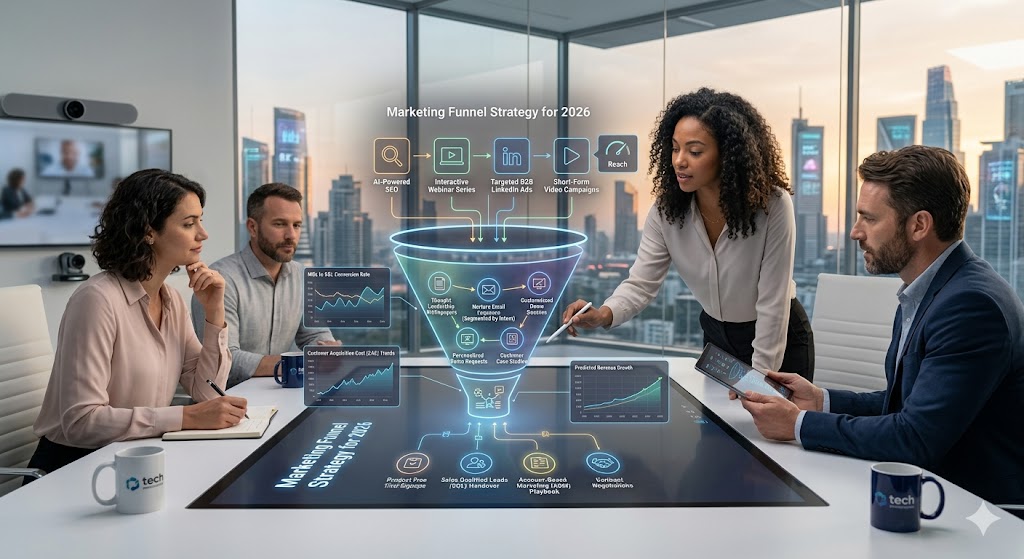
Every successful marketing funnel starts with clarity. You need to know exactly how a customer moves from first discovering your brand to completing a purchase. This is called awareness to conversion mapping. It is one of the most underutilized practices in marketing funnel strategy. Begin by identifying every touchpoint a buyer encounters. This includes social media ads, organic search results, blog posts, email sequences, landing pages, and product pages. Map each one to a specific funnel stage. Awareness content attracts cold audiences. Consideration content helps them evaluate options. Decision content moves them to buy.
Furthermore, use data to understand where most buyers enter and exit your funnel. Analytics platforms like Google Analytics 4, HubSpot, or Mixpanel reveal these patterns clearly. Once you know the most common paths to conversion, you can strengthen them intentionally. Consequently, you reduce the number of buyers who fall off before reaching the end of the funnel.
Aligning Content With Funnel Stages
Content alignment is critical in 2026. Showing a high-intent sales page to someone who has never heard of your brand creates friction, not conversion. Similarly, showing awareness-level content to someone ready to buy delays the sale unnecessarily. Map every piece of content to a specific funnel stage. Top-of-funnel content should educate and attract. Mid-funnel content should build trust and overcome objections. Bottom-of-funnel content should remove risk and confirm value. Moreover, personalization tools now make it possible to serve the right content dynamically. AI-powered platforms can adapt landing pages, emails, and ad creatives based on user behavior. This kind of personalized funnel mapping significantly improves conversion rates across all stages.
Automation Integration
Marketing automation is no longer optional in 2026. Buyers expect timely, relevant communication. Manual follow-up cannot match the speed or consistency that automation provides. However, bad automation is worse than no automation. Generic, impersonal sequences damage brand trust quickly. Therefore, the goal is intelligent automation that feels human.
Start with your email sequences. Map out what happens after someone downloads a lead magnet, starts a free trial, or abandons a cart. Each trigger should launch a relevant, helpful sequence. Use behavioral signals to personalize the messaging. For example, someone who visits your pricing page three times is showing strong intent. An automated sequence that acknowledges this and offers a limited-time incentive can dramatically lift conversion. Additionally, integrate your CRM with your marketing platform. When sales and marketing data share the same system, handoffs become smoother. Leads do not fall through the cracks between departments.
Choosing the Right Automation Tools
The market for marketing automation tools is large. Selecting the wrong platform wastes both money and time. In 2026, look for platforms that combine email automation, CRM functionality, behavioral tracking, and AI-powered personalization. HubSpot, ActiveCampaign, Klaviyo, and Brevo are strong options at different price points. For ecommerce funnels specifically, Klaviyo remains a top performer for revenue-driven automation. Furthermore, platforms with native AI features are becoming increasingly valuable. They suggest optimal send times, predict churn risk, and recommend content based on user behavior. These capabilities improve funnel performance with minimal manual effort. As a result, your team can focus on strategy rather than repetitive execution.
Funnel Leak Diagnosis
A leaking funnel costs revenue silently. Most businesses know their top-line conversion rate but miss the specific stages where buyers are dropping off. Funnel leak diagnosis is the process of identifying exactly where and why this happens. Start with a funnel audit. Map every stage from awareness to purchase. Then assign conversion rate benchmarks to each stage. Industry averages vary, but you should know your own historical baselines. Compare current performance against those baselines.
Also, look for patterns in drop-off. Are visitors bouncing from a specific landing page or Are leads going cold after a particular email in your sequence? Are trial users failing to convert to paid after a certain onboarding step? Each of these signals points to a specific leak. Moreover, qualitative research supplements quantitative data well. User session recordings, heatmaps, and exit surveys reveal friction that numbers alone cannot explain. Tools like Hotjar and Microsoft Clarity provide this insight affordably.
Fixing the Most Common Funnel Leaks
Once you identify leaks, the repair process begins. Common funnel leaks include slow page load times that increase bounce rates. They also include unclear value propositions on landing pages. Weak calls to action that do not create urgency are another frequent issue. Confusing pricing pages or checkout flows also cause significant drop-off. Address each leak systematically. Run A/B tests to validate fixes before rolling them out broadly.
For example, changing a call-to-action button from “Submit” to “Get My Free Report” can lift click-through rates noticeably. Similarly, simplifying a pricing page by removing unnecessary options can reduce decision fatigue and increase conversions. Therefore, treat each funnel stage as a conversion rate optimization opportunity. Small improvements at every stage compound into significant revenue gains over time.
Scaling High-Converting Funnels
Once your funnel is working, the goal shifts to scaling. Scaling a high-converting funnel means driving more volume through a proven system. Many businesses make the mistake of scaling prematurely. They increase ad spend before the funnel is truly optimized. This accelerates losses rather than gains. First, confirm that your funnel is profitable at current volume. Calculate customer acquisition cost and compare it against lifetime value. If the ratio is healthy, scaling becomes a sound investment. Next, identify the top-performing traffic channels. Not all channels convert at the same rate.
Furthermore, paid channels like Google Ads or Meta Ads offer scalable volume when paired with a proven funnel. Organic channels like SEO and content marketing build long-term compounding growth. A balanced scaling strategy uses both. Finally, as you scale, monitor performance closely. Conversion rates can shift under higher volume due to audience quality changes or ad fatigue. Adjust bidding, creative, and targeting accordingly.
Building Systems That Support Funnel Scale
Scaling is not just about spending more money. It requires systems that can handle increased volume without breaking. This means your CRM must be able to manage more leads. Your support team must scale to handle more customers. Your automation must fire correctly at higher frequency. Moreover, content production must keep pace with audience growth. If your funnel depends on regular blog posts, videos, or social content, that production capacity must scale alongside your spend.
Consequently, building or hiring content systems early prevents bottlenecks as you grow. The most scalable funnels are those with the least dependency on individual manual effort. Automate, document, and delegate wherever possible. This creates a funnel that grows with your business rather than one that breaks under the pressure of success.
Conclusion
Marketing funnel optimization in 2026 demands a systematic and data-driven approach. Mapping your awareness to conversion journey gives you clarity. Integrating automation intelligently speeds up follow-up and personalization. Diagnosing and fixing funnel leaks prevents silent revenue loss. Scaling only what is proven avoids wasted investment. The companies winning in 2026 are not necessarily those with the biggest budgets. They are the ones with the tightest, most intentional funnels. Apply the strategies in this guide consistently. Measure everything. Improve continuously. Your marketing funnel is your most powerful revenue asset. Treat it that way.
Frequently Asked Questions
1. What is marketing funnel optimization and why does it matter in 2026?
Marketing funnel optimization is the process of improving every stage of the customer journey from awareness to purchase. In 2026, it matters because buyer behavior is more complex and competition for attention is intense.
2. How do I identify where my sales funnel is leaking?
Use analytics tools to track conversion rates at each funnel stage. Combine this with session recordings and exit surveys to understand why visitors are leaving before converting.
3. What is the best marketing automation tool for funnel optimization?
It depends on your business type. HubSpot suits most B2B companies. Klaviyo is excellent for ecommerce. ActiveCampaign works well for mid-market businesses needing strong behavioral automation.
4. When should I start scaling my marketing funnel?
Scale only after confirming your funnel is profitable at current volume. Check that your customer acquisition cost is well below your customer lifetime value before increasing spend.
5. How does content mapping improve marketing funnel strategy?
Content mapping aligns specific content pieces with each funnel stage. This ensures you deliver the right message to the right buyer at the right moment, which increases conversion rates across the entire funnel.
Read More:
Trust Marketing in an AI-Driven Content World
Online Reputation Management Best Practices: Complete Guide