
Introduction: Why B2B Marketing Must Evolve in 2026
B2B buyers are more informed than ever. They research independently, consult peer reviews, and often make 70% of their buying decision before contacting a sales rep. Consequently, your B2B marketing strategy must meet them where they are — not where you wish they were.
The 2026 B2B landscape rewards businesses that combine thought leadership, precision targeting, technical SEO, and intelligent automation. Generic outreach no longer cuts through. Personalized, data-driven marketing — across the entire funnel — is the new standard. This blueprint gives you a clear, actionable path to build it.
LinkedIn Authority Building
B2B marketing in 2026 starts on LinkedIn. It is the single most powerful channel for building trust with decision-makers at scale. LinkedIn authority is not about posting every day. It is about posting the right things with consistency and strategic intent.
Build Your Personal Brand as a Company Asset
Buyers trust people more than logos. Encourage your founders, sales leaders, and subject matter experts to publish thought leadership content regularly. A post from the CEO sharing a genuine insight reaches ten times the organic audience of a branded company post. Furthermore, personal brand authority transfers directly to your company’s credibility in the sales process.
Content That Builds LinkedIn Authority
- Case study breakdowns — real results from real clients, told as a story.
- Contrarian takes — challenge assumptions your target buyers hold.
- Data-led posts — original stats and insights that spark engagement.
- Behind-the-scenes content — how your team solves real problems.
- Short-form video — LinkedIn’s algorithm currently boosts video 30–50% more than text posts.
📌 LinkedIn Tip: Comment strategically on posts from your ideal clients and partners. Consistent, insightful comments build visibility with decision-makers faster than most B2B advertising spend.
LinkedIn Company Page as a Lead Magnet
Optimize your LinkedIn company page with a clear value proposition in the tagline. Use the featured section to pin lead magnets — free tools, reports, or calculators that capture contact information. Additionally, LinkedIn newsletters are an underused channel for B2B lead generation. Subscribers receive notifications directly, which bypasses algorithmic reach limits.
Account-Based Marketing
Account-Based Marketing (ABM) flips the traditional funnel. Instead of casting a wide net and filtering results, ABM identifies your highest-value target accounts first — then crafts personalized campaigns specifically for them. The result is more efficient pipeline, shorter sales cycles, and dramatically higher deal values.
Building Your Ideal Customer Profile (ICP)
Effective ABM starts with a precise Ideal Customer Profile. Analyze your best existing clients — those with highest LTV, shortest sales cycles, and strongest advocacy. Look for patterns in company size, industry, tech stack, revenue, growth stage, and buying committee structure. That profile becomes your targeting foundation for all B2B selling activities.
Tiered ABM Strategy
🎯 Tier 1 — 1:1 ABM: Fully bespoke campaigns for 10–50 named accounts. Custom landing pages, executive gifting, personalized outreach sequences.
📋 Tier 2 — 1:Few ABM: Industry-level personalization for 50–200 accounts. Sector-specific content, tailored ad creative, and customized email sequences.
📢 Tier 3 — 1:Many ABM: Persona-level targeting for 200–1000 accounts. Broad but segmented B2B advertising, retargeting, and content marketing.
📈 Demand Gen: Top-of-funnel B2B marketing strategy to attract net-new accounts into your ICP pool continuously.
ABM Channels That Drive B2B Results
LinkedIn paid ads with account targeting are the most precise B2B advertising channel available. Pair them with personalized landing pages, intent data tools like Bombora or 6sense, and coordinated sales outreach for maximum impact. ABM is not a marketing-only motion — it requires tight alignment between your B2B marketing agency or internal team and sales.
SEO for B2B
B2B buyers use search at every stage of their journey. They search for problems, compare solutions, and validate vendors — all before your sales team knows they exist. A strong SEO strategy ensures your business appears precisely at those moments. That visibility drives inbound B2B lead generation at the lowest possible cost per acquisition.
B2B SEO Is Different From B2C
B2B search volumes are lower. However, the intent is far more specific and the conversion value far higher. A single page ranking for a high-intent B2B keyword can generate hundreds of thousands of dollars in pipeline annually. Focus on quality over volume. Target keywords that signal buying intent, not just research curiosity.
| Keyword Type | Example | B2B Value |
|---|---|---|
| Problem-Aware | “how to reduce customer churn” | High — catches early-stage buyers |
| Solution-Aware | “best CRM for enterprise B2B” | Very High — comparison stage |
| Vendor-Aware | “[competitor] alternative” | Highest — ready to switch |
| Use-Case | “B2B marketing strategy for SaaS” | High — specific audience fit |
Content Strategy for B2B SEO
Build content clusters around your core service categories. Each cluster has one pillar page — a comprehensive, authoritative piece — supported by several related supporting articles that link back to it. This structure signals topical authority to search engines and guides buyers through your content naturally.
Furthermore, technical SEO matters enormously in B2B. Site speed, Core Web Vitals, mobile responsiveness, and structured data all influence whether your content ranks. Work with a B2B marketing agency or in-house SEO specialist to conduct quarterly technical audits and stay ahead of algorithm updates.
Lead Scoring & Automation
Not all leads deserve the same sales attention. Lead scoring assigns numerical values to lead behaviors and firmographic data, helping your team focus energy on prospects most likely to convert. Combined with marketing automation, it transforms your B2B sales process from reactive to predictive.
Building a Lead Scoring Model
Start with two dimensions: demographic fit and behavioral engagement. Demographic scoring rewards leads that match your ICP — right industry, company size, revenue, and geography. Behavioral scoring rewards actions that indicate buying intent — visiting pricing pages, downloading case studies, attending webinars, or opening multiple emails in a short period.
- +20 points — Matches ICP industry exactly
- +15 points — Visited pricing page
- +12 points — Downloaded a case study
- +10 points — Opened 3+ emails in one week
- +8 points — Attended a webinar
- −10 points — Job title outside buying committee
- −15 points — No engagement in 60+ days
Automation Workflows That Drive B2B Lead Generation
Marketing automation nurtures leads through long B2B buying cycles without demanding constant manual effort. Set up trigger-based email sequences that respond to specific lead behaviors. A lead who visits your case studies page three times should receive a personalized email from a sales rep within the hour — not a generic newsletter three days later.
⚡ Automation Win: Businesses that respond to high-intent lead signals within 5 minutes are 9× more likely to convert that lead than those who wait 30+ minutes. Automation makes that speed possible at scale.
Aligning B2B Marketing and Sales Around Lead Data
Lead scoring only works when marketing and sales agree on the thresholds. Define your Marketing Qualified Lead (MQL) and Sales Qualified Lead (SQL) criteria together. Establish a formal handoff process with SLA commitments — for example, sales must follow up on any SQL within 24 hours. Track the conversion rate from MQL to SQL to closed-won to identify gaps and improve continuously.
Putting the Blueprint Together
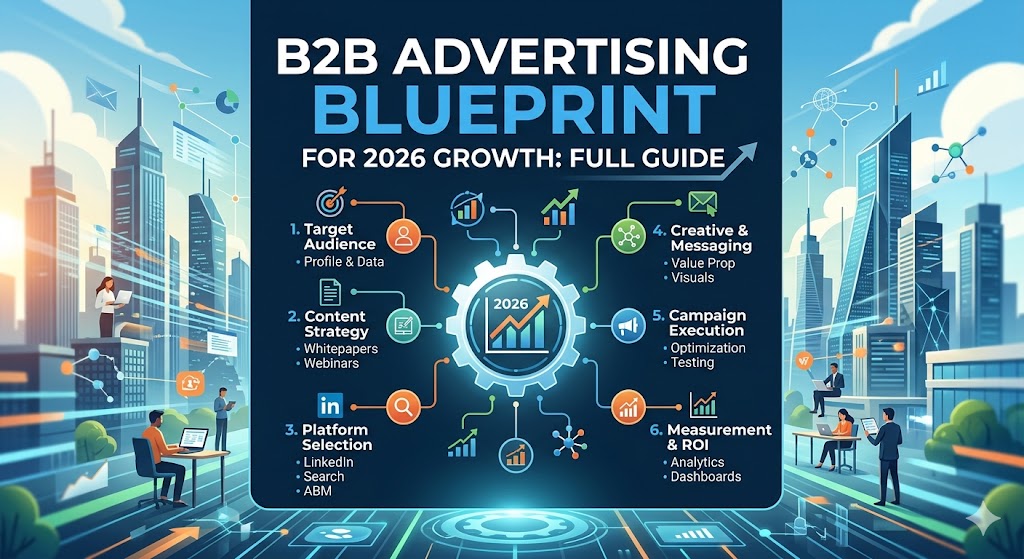
The four pillars of this blueprint — LinkedIn authority, account-based marketing, B2B SEO, and lead scoring automation — are not independent. They work as a unified system. LinkedIn authority generates awareness and warms accounts. ABM converts that awareness into pipeline. SEO captures inbound demand year-round. Lead scoring and automation ensure no high-intent prospect falls through the cracks.
Additionally, measurement ties everything together. Track pipeline attributed to each channel. Monitor content-influenced deals. Review your lead scoring model quarterly and adjust thresholds based on actual conversion data. The best B2B marketing strategy is one that continuously learns and improves.
Conclusion
B2B marketing in 2026 rewards businesses that are specific, strategic, and relentlessly focused on their ideal buyer. Build LinkedIn authority that earns trust before the sales conversation begins. Deploy ABM to pursue your highest-value accounts with precision. Invest in SEO to generate compounding inbound demand. Use lead scoring and automation to convert that demand efficiently.
Together, these pillars form a B2B digital marketing engine that scales with your business, reduces reliance on expensive paid channels, and builds durable competitive advantage. Start with one pillar. Layer in the others. The results will compound — and your pipeline will thank you for it.
Read More: