
Email marketing

Ad optimization, Ad Security, affiliate marketing, AI Adoption, AI Advertising, AI Chatbots, ai content, AI investment, AI Marketing, Audience Scaling, Audio Content Marketing, Brand Awareness, Brand Markeing, Customer Behavior, Customer Service, Digital Marketing, digital PR, digital transformation

How Does Customer Retention Work Simply? A Complete Guide

Customer Retention Marketing Strategy for Long-Term Growth Acquiring new customers costs far more than keeping existing ones. Yet many businesses focus almost entirely on acquisition. This imbalance leaves growth potential untapped. A strong customer retention marketing strategy changes this equation completely. It turns one-time buyers into repeat customers and loyal advocates. This guide covers the key building blocks of effective retention marketing, including loyalty programs, retention flows, upsell strategies, and lifetime value measurement. Business owners, marketers, and startup founders will find practical steps to apply immediately. No matter your industry, the core idea stays the same. Customers who feel valued and understood keep coming back. Building a system around that idea, rather than relying on one-off promotions, creates compounding growth over time. The following sections break down exactly how to build that system piece by piece. Loyalty Programs for Customer Loyalty programs reward customers for continued engagement with your brand. Points, tiers, and exclusive perks all encourage repeat purchases. When done well, these programs make customers feel valued rather than just targeted. A simple points system works for many businesses starting out. Customers earn points per purchase and redeem them for discounts or free products. Additionally, tiered programs reward your most loyal customers with better perks over time. This creates a sense of progress and achievement. Gamification elements, such as progress bars toward the next reward tier, can further boost engagement. Customers enjoy seeing tangible progress toward a goal. This visual feedback encourages them to make another purchase sooner than they otherwise might. However, loyalty programs must stay simple to succeed. Complicated rules confuse customers and reduce participation. Therefore, keep the structure clear and the rewards meaningful. A well-designed loyalty program directly supports your broader repeat purchase strategy. Consider offering early access to new products for top-tier members. This kind of perk feels exclusive without costing much to deliver. Similarly, birthday rewards or surprise bonuses create positive emotional moments that customers remember. These small touches often matter more than the size of the discount itself. Email & SMS Retention Flows Automated email and SMS flows keep your brand present without constant manual effort. These messages remind customers to return, celebrate milestones, and highlight relevant offers. Timing and relevance matter more than frequency. Post-purchase flows are a great starting point. Send a thank-you message, followed by product tips, then a review request. Similarly, win-back flows target customers who have not purchased in a while. A well-timed discount or reminder can reactivate a dormant customer. SMS works well for time-sensitive offers due to high open rates. Meanwhile, email suits longer content like guides or loyalty updates. Combining both channels creates a consistent retention experience. This approach keeps customers engaged throughout their entire journey with your brand. Segment your audience before sending any retention message. A first-time buyer needs different messaging than a customer who has purchased ten times. Consequently, tailored flows perform better than generic blasts sent to your entire list. Testing subject lines and send times also improves open rates over time. Upsell & Cross-Sell Strategy for Customer Retention Upselling and cross-selling increase revenue from existing customers without new acquisition costs. Upselling encourages customers to choose a higher-value option. Cross-selling suggests complementary products that add value to their purchase. Timing plays a critical role in both strategies. Offering an upsell during checkout often works better than after the sale is complete. In contrast, cross-sell suggestions work well in follow-up emails once customers have used the initial product. This spacing prevents the offer from feeling pushy. Testing different placements helps identify what works best for your audience. Some customers respond well to in-app suggestions, while others prefer email-based recommendations sent a few days after purchase. Running small experiments before scaling a tactic across your entire customer base reduces the risk of a poor experience. Personalization also improves results significantly. Recommendations based on past purchase behavior feel relevant rather than random. As a result, customers are more likely to accept the suggestion. A thoughtful upsell and cross-sell strategy strengthens both revenue and customer satisfaction. Bundling is another effective tactic within this strategy. Grouping complementary products at a slight discount encourages larger orders. Meanwhile, showing “customers also bought” suggestions on product pages captures interest at the right moment. These tactics work best when they genuinely add value rather than simply pushing more products. Measuring Lifetime Value for Customer Customer lifetime value, or LTV, shows the total revenue a customer generates over time. This metric helps businesses understand which retention efforts truly work. Without measuring LTV, retention strategies are just guesses. Calculating LTV involves average purchase value, purchase frequency, and customer lifespan. Tracking this number over time reveals trends in customer behavior. Furthermore, segmenting LTV by customer group shows which audiences respond best to retention efforts. This data guides smarter marketing investment decisions. Businesses should review LTV alongside acquisition costs regularly. This comparison shows whether retention marketing is delivering real returns. Consistent tracking turns retention from a nice idea into a measurable growth driver. For example, a business might discover that customers who join a loyalty program have a noticeably higher LTV than those who do not. This insight justifies further investment in loyalty features. Similarly, tracking LTV by acquisition channel reveals which marketing sources bring in the most valuable long-term customers, not just the cheapest ones. Bringing the Strategy Together for Customer Loyalty programs, retention flows, upsell tactics, and LTV tracking work best as a connected system. Each element supports the others. For example, loyalty data can inform which customers receive personalized upsell offers. Meanwhile, retention flows can highlight loyalty rewards to boost participation. Start with one element if resources are limited. Many businesses begin with email retention flows due to their low cost and high impact. From there, add loyalty programs and refine upsell strategies as data becomes available. This phased approach builds a sustainable customer retention marketing strategy over time. It also helps to assign clear ownership for each piece of the strategy. One team member might manage loyalty program performance, […]
AI Marketing, content strategy, Digital Marketing, digital marketing for dental, Digital Marketing for Restaurants, digital PR, digital transformation, Email Automation, email marketing, Marketing Automation, Semantic SEO, SEO

How Do Advanced Email Automations Work? Complete Guide

Advanced Email Automation Sequences Email remains one of the strongest marketing channels available today. However, sending random emails no longer works well. Businesses need a smart email automation strategy to stand out. Advanced email funnels help brands guide customers step by step. These funnels nurture leads, respond to behavior, and win back inactive users. Done right, they drive real revenue. This blog covers four key parts of a strong email automation strategy. You will learn how to build sequences that engage readers and grow your business. Marketers at every level, from small teams to large enterprises, can apply these ideas. The goal is simple: send the right message to the right person at the right time. Welcome & Nurture Sequences A welcome sequence is your first chance to impress new subscribers. This series should introduce your brand and set clear expectations. A strong welcome email often gets the highest open rates of any email you send. Start with a short thank-you email. Confirm the subscription and share what readers can expect. For example, mention how often you will send emails and what value they offer. Next, build a nurture sequence around education. Share helpful tips, product guides, or customer stories. This content builds trust before you ask for a sale. Avoid pushing offers too early in the sequence. Timing matters greatly here. Space emails a few days apart to avoid overwhelming new subscribers. Additionally, use simple language and clear calls to action throughout the sequence. Personalization strengthens this process further. Use the subscriber’s name and reference their sign-up source when possible. A tailored welcome sequence often leads to stronger long-term engagement. A strong welcome sequence typically spans three to five emails. The first builds excitement, the middle emails provide value, and the final email introduces a soft offer. This gradual approach feels natural rather than pushy. Segmentation can improve results even further. New subscribers from a webinar may need different content than those from a product page. Tailoring your nurture sequence to sign-up source often increases engagement significantly. Mobile-friendly design deserves attention too. Many subscribers open emails on their phones first. Short paragraphs, clear buttons, and simple layouts help your welcome sequence perform well across every device. Behavioral Triggers Behavioral triggers send emails based on specific actions. This approach makes your email automation strategy far more relevant. Instead of blasting the same message to everyone, you respond to real behavior. Cart abandonment emails are a common example. When a shopper leaves items in their cart, an automated email can remind them to complete the purchase. These emails often include a gentle nudge or a small incentive. Browse abandonment works similarly. If someone views a product but does not add it to their cart, a follow-up email can highlight that item. This keeps your brand visible without feeling pushy. Engagement-based triggers also work well. For instance, you might send a special offer after a subscriber clicks a specific link multiple times. This shows genuine interest, making them a strong candidate for a targeted offer. Setting up these triggers requires reliable automation software. Most modern email platforms support this feature. Once configured, these sequences run automatically, saving time while boosting conversions. Purchase-based triggers extend the relationship beyond the first sale. A follow-up email asking for product feedback, or suggesting a complementary item, keeps customers engaged. This approach often increases repeat purchases over time. Timing plays a critical role in trigger performance. Cart abandonment emails, for example, work best when sent within one to three hours. Waiting too long often means the shopper has already lost interest or bought elsewhere. Milestone triggers offer another creative option. A message celebrating a customer’s one-year anniversary, or a loyalty milestone, adds a personal touch. These small gestures often strengthen long-term brand loyalty. Re-Engagement Campaigns Every email list includes inactive subscribers over time. Re-engagement campaigns aim to win these people back before you remove them. This step protects your sender reputation and improves overall list health. Start by identifying inactive users. Most platforms let you filter subscribers who have not opened or clicked emails within a set period, such as 90 days. This group becomes your re-engagement target. Send a direct message asking if they still want to hear from you. Keep the subject line honest and simple. Phrases like “We miss you” or “Are you still interested?” often perform well. Offering an incentive can help too. A discount code or exclusive content may encourage inactive users to engage again. However, avoid discounting too heavily, as this can hurt your brand value. If subscribers remain inactive after the campaign, consider removing them from your list. This may feel counterintuitive, but it keeps your advanced email funnels efficient. A smaller, engaged list often performs better than a large, inactive one. A well-built re-engagement sequence usually includes two or three emails. The first email checks in casually. If there is no response, the second email can offer an incentive or ask for feedback directly. Sender reputation improves noticeably once inactive subscribers are removed. Internet service providers track engagement closely. A cleaner list often means better inbox placement for every future campaign you send. Timing your re-engagement campaign matters too. Sending it right before a major sale or product launch can give hesitant subscribers a reason to open your email again and stay on your list. Measuring Email Automation & ROI Tracking results is essential for any email automation strategy. Without clear metrics, you cannot know what works. Regular measurement helps you refine your advanced email funnels over time. Start with open rates and click-through rates. These numbers show how well your subject lines and content perform. Low open rates often signal a need to improve subject lines or sender reputation. Conversion rate matters even more. This metric tracks how many recipients complete a desired action, such as making a purchase. Compare conversion rates across different sequences to find your strongest performers. Revenue per email is another valuable metric. This number shows the direct financial impact of your campaigns. […]

Branding, Conversion Optimization, Digital Marketing, E-commerce, Ecommerce Marketing 2026, Ecommerce Sales, email marketing, Performance Ads

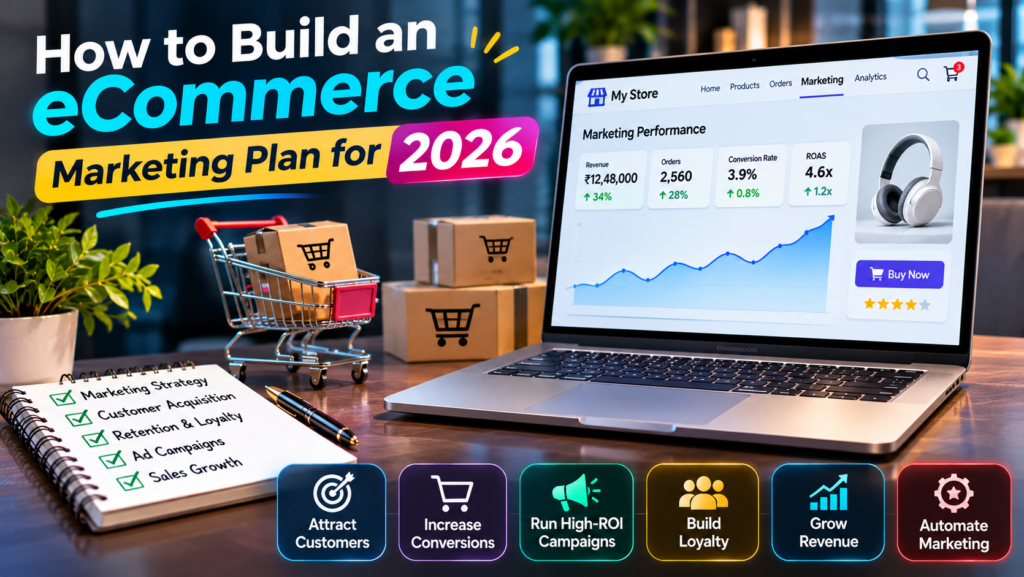
How to Build an Ecommerce Marketing 2026 Plan

Ecommerce is more competitive than ever. In 2025, global ecommerce sales are expected to surpass $6.8 trillion. However, getting a slice of that revenue requires more than a great product. It demands a smart, data-driven ecommerce marketing strategy that converts browsers into buyers and buyers into loyal customers. This guide covers the four most important pillars of ecommerce growth strategy in 2025. Specifically, these are performance ads, email and SMS automation, conversion optimisation, and retention. Each one builds on the other. Together, they form a system that drives compounding, sustainable growth. Performance Ads Structure Performance advertising is still one of the fastest ways to drive ecommerce traffic. However, the landscape has changed dramatically. iOS privacy updates, third-party cookie deprecation, and rising CPMs mean your ad structure needs to be smarter than ever. First, build your campaigns around a clear funnel structure. At the top of the funnel, use broad audience prospecting campaigns on Meta and Google. These introduce your brand to new potential customers. Additionally, use video creatives here — they perform significantly better than static ads for cold audiences. In the middle of the funnel, retarget engaged visitors with specific product ads, reviews, and social proof. Consequently, you bring back shoppers who showed interest but did not yet purchase. Use dynamic product ads (DPAs) to show people exactly what they viewed or added to cart. At the bottom of the funnel, close the sale. Use urgency-driven messaging — limited stock, price drops, expiring offers. Moreover, layer in customer testimonials and trust signals to address last-minute hesitations. For Google Shopping in 2025, Performance Max (PMax) campaigns dominate. However, supplement them with standard Shopping campaigns to maintain control over high-performing product categories. Additionally, use branded search campaigns to protect your brand terms from competitor bids. Always test creatives aggressively. Run at least 3-5 creative variations per ad set. Furthermore, use Meta’s Advantage+ Shopping Campaigns for proven product lines — they often outperform manual campaign structures for scaling. Keep a close eye on your MER (Marketing Efficiency Ratio) rather than relying solely on platform-reported ROAS. Email & SMS Automation Email and SMS remain the highest-ROI channels in ecommerce marketing. In fact, email generates an average return of $36 for every $1 spent. Therefore, building a robust automation system is non-negotiable for any serious ecommerce growth strategy. Start with your core automations. The welcome series is your most important flow. New subscribers are highly engaged. Consequently, a 3-5 email welcome sequence that introduces your brand story, best sellers, and a welcome offer can drive significant early revenue. Next, build an abandoned cart sequence. Send the first email within one hour of cart abandonment. Follow up again at 24 hours and 72 hours. Additionally, add an SMS touchpoint at the 24-hour mark for high-intent shoppers — conversion rates for SMS cart reminders often exceed 10%. Browse abandonment flows target visitors who viewed products but did not add to cart. These tend to be shorter — two to three emails maximum. Furthermore, personalise them with the specific products viewed for maximum relevance. Post-purchase flows are critical for retention. Send a confirmation, then a value-add email (how-to content, tips, or related products). Additionally, follow up at day 7 and day 21 to encourage repeat purchase. This is where loyalty is built. For SMS, keep messages short and direct. Always include a clear CTA. Moreover, segment your SMS list carefully — high-frequency messaging to unengaged subscribers damages your sender reputation and drives opt-outs. Aim for 4-8 SMS sends per month maximum. Klaviyo, Omnisend, and Attentive are the leading platforms for ecommerce email and SMS in 2025. Each integrates deeply with Shopify and most major platforms. Furthermore, use predictive analytics within these tools to identify at-risk customers before they churn. Conversion Optimisation Driving traffic is only half the battle. Conversion optimisation ensures that traffic actually turns into sales. Even a 1% improvement in your conversion rate can dramatically increase revenue without adding a single extra visitor. Start with your product pages. These are the highest-impact pages for most ecommerce stores. Ensure every product page has high-quality images from multiple angles, a clear and benefit-led headline, detailed but scannable descriptions, visible reviews and ratings, and a prominent, fast-loading Add to Cart button. Page speed is a conversion killer. Research shows that a one-second delay in load time reduces conversions by up to 7%. Therefore, optimise images, reduce JavaScript, and use a fast CDN. Additionally, test your site speed on mobile — in 2025, over 70% of ecommerce traffic comes from mobile devices. Use heatmaps and session recordings to understand where users drop off. Tools like Hotjar or Microsoft Clarity reveal exactly what shoppers do on your pages. Consequently, you can identify friction points that are hard to spot from analytics alone. Run A/B tests systematically. Test one element at a time — headline, CTA text, image layout, price display, social proof placement. Furthermore, use tools like VWO or Google Optimize to run tests with statistical confidence before making permanent changes. Checkout optimisation deserves special attention. Simplify your checkout to as few steps as possible. Offer guest checkout. Display trust badges prominently. Moreover, support multiple payment methods — including Buy Now Pay Later options like Klarna or Afterpay, which can boost average order value by 20-30%. Finally, personalisation drives conversion. Show returning visitors personalised product recommendations based on their browse and purchase history. Additionally, use dynamic homepage content to reflect the customer’s preferences. Personalised experiences convert at 2-3x the rate of generic ones. Retention Strategy Acquiring a new customer costs 5x more than retaining an existing one. Yet most ecommerce brands spend 80% of their marketing budget on acquisition. Flipping that balance — even slightly — can transform profitability. A strong retention strategy starts with your loyalty programme. Points-based systems work well for high-frequency purchases. However, for lower-frequency categories, a tiered VIP programme creates aspiration and drives repeat purchases. Moreover, make rewards easy to understand and redeem — complexity kills loyalty programme engagement. Subscription models are one of the […]

Brand Markeing, Digital Marketing, email marketing, Search Engines, SEO Marketing, social media marketing, social meia marketing

Why Online Marketing Has Become So Important For Companies?

With modern changes and evolutions small and basically everything they can to keep up. The old-fashioned marketing efforts are now supplemented with hip digital marketing strategies. It all happens online to book. Because if well thought out, online marketing often leads to more website visits and conversions. Companies focus on the tangible results that online marketing is known for. Companies are excited to get started with the click-through rates and see if the bounce rates have dropped even further. It is obvious; online marketing has taken on a central role within many companies. Why has online marketing become so important to many businesses? We summarize it in a number of developments. Online Marketing Levels The Playing Field : Fortunately, the days when online marketing campaigns were only intended for large companies and multinationals. Digital marketing is leveling the playing field and giving small and medium-sized businesses the chance to compete against the big boys. In addition, expensive call centers and physical offices are no longer necessary to compete. Effective online marketing can also be performed by small, decisive parties. For making your company visible online through means of digital marketing. Social Prefix will help you with all kinds of sources such as SEO, SMO, PPC, and Email Marketing you might require to make your company online and reach your potential customers. More Interaction With The Target Group : One of the reasons why online marketing is taking over traditional marketing channels is the power to communicate with the target audience in real time. Involvement is the keyword here. With sufficient interaction, you can really find out what your target group wants. A simple post with many comments on Facebook can provide a lot of new insights. And what about a Q&A webinar in which you have live contact with your target group? Companies know better than ever what their customers want. The interaction with the target audience can be done through Social Media Marketing. Social Prefix will help your business to interact with the target audience through Social Media Marketing such as making the post, efficient use of the content, and many more. The Customer Can Be Reached Anytime And Anywhere By Smartphone : We don’t need to explain how intensive the average smartphone use is. One percentage is even higher than the other, but they all say the same thing: the smartphone user dictates. This development has completely changed the playing field: orders can be placed from the pocket, online advertisements are adapted to smartphone use, and the influence of video advertisements is enormous. Online marketing changes along with the user. And if it’s mobile, so is online marketing. Building Trust Is Faster Than Ever : The social media platform is a company’s digital face, and its transparency allows users to freely comment on products, brands, and companies. If you manage to do this smartly as a company, you ensure that your target group grows into an ambassador for your product. Are you committing a blunder? Then everyone will know too.  In order to generate trust, you need to be open and interact with your target group. You will be able to receive orders faster the more trust they have in you. Take Action At The Touch Of A Button : The purpose of online marketing is not to force, but to stimulate. People have taken immediate action as a result of online marketing, among other things. Immediately call by pressing a button and conveniently click through to the order page. Converting visitors through calls-to-action has been a success for online marketers. Not only do the buttons, images, and colors do the work, also simple payment methods such as Paytm and PayPal have enriched the online world. Through this, you may come to know how important digital Marketing is in the online business world. Digital Marketing not only requires making the website or opening your google business it also requires Social Media Marketing, Email Marketing, SEO, and much more, to reach your customers. Social Prefix is an online platform that will help you with all of your this requirement. You just have to let them know your requirements, your Target Audience and that’s it.

Brand Markeing, Digital Marketing, email marketing, SEO Marketing, social media marketing

Why A Website Is Needed For Every Business?

          I think most people now agree that having an online presence is the key for almost every company. The internet has revolutionized the old way of marketing. If you are not online, you are invisible.  In many cases, a website can be used as an ’employee’ and as a tool for your company. But not only this, if you are not on the internet, how do your customers find you? 40-50% of companies do not have a website. Moreover, the majority of these website owners do not keep their websites up to date. This will give you an idea of ​​how competitive you could be in the market right now. Social Prefix will help you to build your presence online and also help you to reach your potential customer. Is a website really necessary for your business? Almost every modern business in the world has a website and it’s for a reason. In this article, we explain to you what the advantages are of a website and why you as an entrepreneur can use it. You Gain Credibility : A website is the best way to collect all your work and use it as a portfolio or for your products. Here you can display any testimonials or grades to promote your business. Customers search for products or brands. When a customer cannot find you on the internet, it creates mistrust. But if this customer finds your beautiful website, this can lead to an assignment/order. Social Prefix helps you to gain a such type of credibility by making your company’s presence online. And different Marketing Strategies help you to reach your potential customers. With This, You Can Keep Your Customers Informed Not only can you use your website to sell products or services, but you can also use it to keep visitors informed of your developments. Do you have a new service, a new product, or an offer? Report this on your website. You can then share these messages on Facebook, LinkedIn, and other networks to draw attention to them. This way you create an opportunity to get visitors more involved with your company. As you got to know how important it is to keep your customers updated. These things always required the Best Marketing Strategies, Marketing efforts, and much more.  This kind of service requires different intelligence with different charges. But what if we say all these things are possible without attending to different personnel? Yes, Social Prefix will handle your marketing work regarding your Business and make your presence Online. A Website Raises Awareness About Your Brand Your website and social media pages are available 24/7, 365 days a year, potentially reaching thousands of people per month. So make sure you maintain your website well and don’t let it become outdated. It’s important to make sure you’ve instructed website builders to use all of your keywords when your site is under development and use them consistently when posting to social media or a blog. This way your website will be found more often on the internet and others will see you more often online in their search results. It Makes Money, So It’s Worth The Investment Many companies make the mistake of not setting aside marketing budgets, they feel it is not important for now, and they already have customers. But actually, one of the biggest expenses a company makes is the design and development of any online or offline media release. Most of your budget will probably be spent on the website, this makes sense. When the website is ‘properly’ made, it can function as an extra ‘online store’. Think of it as the most prominent property in your city. Imagine if you were sitting here with your company. Then you will be seen anyway! By doing the same online you will certainly be seen more. In addition, you can ensure that you are seen by people who are also looking for you. The greater the chance that a visit will lead to an assignment/order. Not only developing a website will help you to reach your potential customers. Many other factors are also required such as SEO, Content Strategy, Lead Generation, and many more. Social Prefix will help you in every stage of Digital Marketing. So that your website will be found on your customer’s Search Engine Result Page.  Improved Customer Service By clearly stating your contact details on the website, customers can reach you more easily. This prevents frustrations and improves the customer experience. When a customer can contact you directly, this ensures that you can quickly solve the problem before the customer becomes dissatisfied. Invite people to your site to ask questions and get in touch. This gives you a chance to connect with a visitor and inform them about your services or products. All a customer wants is to find what they are looking for within 30 seconds. Is a visitor lost on your website? Then they will probably go to your competitor. So be clear, focused, and transparent in your communication.

Brand Markeing, Digital Marketing, email marketing, SEO Marketing, social media marketing

4 Essential Skills Every Digital Marketer Needs to Know

Digital marketing is not always about pitching your customers for your product and services, because there are so many companies who provide the same services so why they will choose you? So, It is about what special values you are providing to them, the main thing in marketing is to build trust for your customers, so they can believe that you are the only person who can address their problems, which they are already facing in their life. You should always try to give the best solution to their problems, what no one else is giving to them, so when the time comes for them to choose the best solution from the market they always choose you. You should have built that kind of trust in the mind of your target audience. The most important thing is how to assure your customers that you are the only company that can help them. Digital marketing is not different from traditional marketing the only thing is the dialogue occurs over the digital platforms such as Social media, Google ads, Blogs, and there are few more platforms where the marketing occurs. In this blog, we will discuss 4 digital marketing skills that are crucial for understanding digital marketing. 1. Copywriting It is one of the most important skills that all digital marketers should know, it helps to make things sell better because it is prompting. Every marketer needs copywriting for email, social media, paid ads, event invitations, and landing pages it all requires copywriting. Copywriting is a very different skill from other writing skills because it captures the attention of the audience also with this, you can communicate better and, you can encourage the audience to take any action to buy your product or services. With this special skill, you can grab or shift the attention of your potential customers. If you will check on the internet you will get so many tools to improve for the same. Related Topic: Reasons to use Memes in your digital marketing 2. SEO Nowadays, almost all people depend on the internet, that’s why they always take suggestions from google search engines to buy anything whether it is food to eat or a mobile phone to use, A person always depends on the internet whether they are looking for the nearest restaurant, nearest club or they want to do a comparison of anything, consumer depends on the search engine to make themselves make confident in their purchasing decisions. As such, to know how to get a business to appear on which relevant searches is important, SEO is very important for every business who wants to drive their business online and get customers. You need to know to secure your website and how to produce and promote useful content. It is a very important investment for your business it takes time because it is organic, but it promotes your business on the top of the search engine, it is very hard to maintain your website rank on google and other search engines. So whether you are trying to polish your skills or start practicing them, you should know it will take time. You can take the help of some tools which are already available on the internet, which can help you and let you know what corrections and changes need on your title tag, meta description, headings, alt tags, and interlinks. Related Topic: 5 secrets to launching a Brand in 2021 3. PPC The organic practice is good to rank up your business on search engines but, it takes time. But if you want to get the instant result and gain relevant visibility more immediately then, it will be possible through PPC pay-per-click advertising. With PPC your business will show guaranteed on the top spot of the Google search engine, but it is not free you have to pay for each click of your ads, if you are paying for your ads it doesn’t mean your ad will always be on the top of the google search engine, because ad relevancy and quality of your ad is also played an important role. When we talk about quality and relevancy it means, the quality of your ad should be great and your ad relevancy should match with the intent of the audience, this is what makes PPC a skill, but It is not only about the quality and relevancy you should also have to manage your budget and you need to know which keywords you have to target, and which best channel and ad format to use, and how to create the best experience for your audience because, if your ad will be better you will have to pay less on each click and your profit will be hight. Related Topic: How are email marketing benefits businesses? 4. Email Marketing Email marketing used for ages, and yet it is still a very effective way of marketing, and it also cost less. This marketing strategy is one of the most popular skills and every marketer should know this skill, it helps to engage dormant customers, it helps to convert leads, it helps to build trust, and more. With this, you can send product promotional emails, important updates, useful content, exclusive deals, etc. With this skill, you can grab the attention of your target audience and remember them anything regarding your goals. Credits: Arun Chauhan

Scroll to Top